When the Ashes Find a Voice
From the ground beneath our feet to the people beside the campfire, we are giving the world a richer sound—and sharing the first local speech experiments.
23 October 2026 · The Epos of Ashes Team · 5 min read
Cover: Audio waveform visualisation · Development samples
We have spent a lot of time looking at Epos of Ashes. Trees, coastlines, windows, the shape of a cave: each has had its turn under a very bright development light. Now we are spending more time on what the world tells us when we stop looking at it.
Parts of that world have often been quiet. Our aim is not to fill every silence. It is to make a footstep tell you something about the ground, a warning stand apart from a spell, and a person sound as though they belong beside that particular fire.
This week has given us two different beginnings: a library of synthesised sounds, and our first working local speech experiments. They are useful steps towards a more expressive world. They are not a finished full voice-over.
The ground should have something to say
Think of the journey from grass to a wooden crossing, then onto sand at the shore. We want those changes to register without requiring another glance at a label. The new footstep set contains nine materials, with three variants each: earth, grass, sand, stone, wood, snow, leaves, mud and water. The source integration also gives landings a matching surface.
That is one part of a first library of 91 original procedural WAVs, together a little over seven minutes. It includes three music loops, seven regional atmospheres, weather, player feedback, combat, wave warnings and UI sounds. The 24 creature sounds are synthetic sketches, rather than recordings of animals or actors. This library was made through synthesis and sound layering, separately from the speech model described below.
We have also built an audio laboratory where we can search by category, play a sound on demand, and compare music and atmosphere with separate loop and volume controls. Having a place to ask “which sound is this?” is valuable before trying to judge everything together in the world.
Atmosphere, without everything speaking at once
The intent is for forest, winter, desert, swamp, coast, scar and volcanic surroundings to have distinguishable sound beds. Those audio categories do not, by themselves, announce new playable regions. Weather should follow the local scene; a cave should make the outdoor atmosphere recede rather than carry the whole landscape inside with you.
Combat needs a different kind of clarity. Frost and thorns have separate cues; protection has a cast sound and a response to an intercepted hit. Wave warnings, outcomes and small interface actions have their own connections. Music has separate exploration, camp and combat moods, with transitions rather than an abrupt restart at every change.
There are important limits here. The source wiring for steps, combat, creature feedback and regional weather compiles, but its current content/session build and runtime acceptance are still pending. Wave, UI and music work has separate targeted tests. Neither establishes a finished mix or proves that an older player build contains the new soundscape. Some prepared clips have no playable event yet: a roll sound is not evidence that we added a dodge mechanic.
The next useful judgement is a shared listening pass: what is too loud, what repeats, what helps, and what merely gets in the way. File checks cannot answer those questions for us.
Four small voices from the workshop
The speech experiments are a separate process. We now have a local workshop using Qwen3-TTS, where we can try text and vocal direction on our own machine; the checked generation run used local models without a cloud audio API or network access.
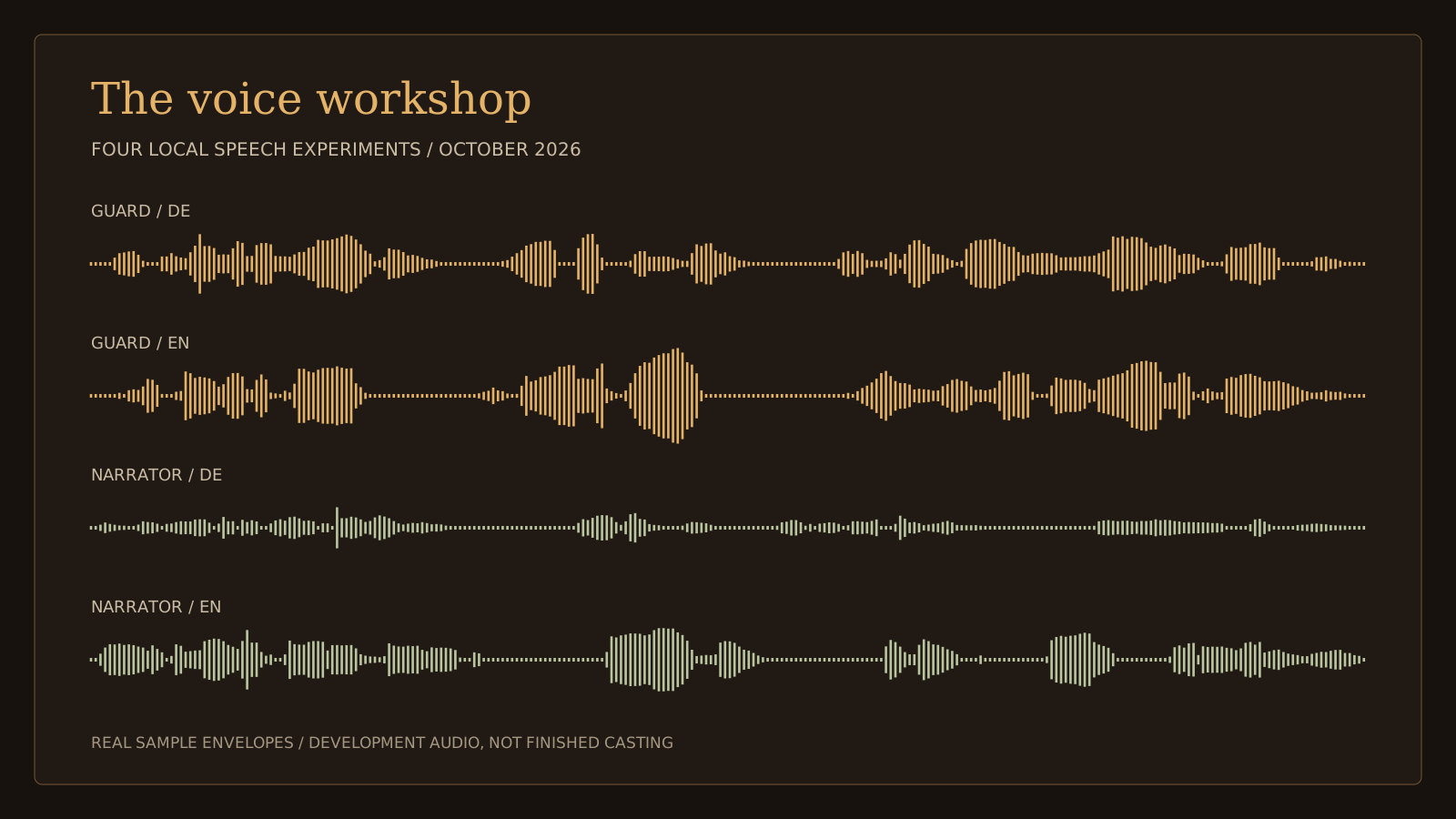
The first four clips try two model voices, Ryan and Vivian, in German and English. Clemens accepted these as a fitting starting point. That is encouraging without settling pronunciation, acting or the eventual casting of the game's characters. These are AI-generated workshop readings, not human recordings, voice clones or finished scenes.
Choose a language below to hear that starting point. Nothing plays automatically; switching language stops the current reading. Each sample includes its source text; the guard and narrator are test roles, not assignments to named characters. In particular, the narrator sentence is a voice exercise, not a revision to the story of the fire that never fully went out.
The voice workshop
Choose a language to hear the readings.
English · 2 workshop readings · Play to listen
Guard direction
Welcome to the camp. Stay on the path. Wolves are lurking beyond the trees.
Ryan · 3.92 seconds · AI-generated development sample
Narrator direction
As the last ember faded, a new hope awoke beneath the ashes.
Vivian · 8.72 seconds · AI-generated development sample
All four saved files passed their format and signal checks. That verifies the files, not universally perfect speech. Two validated model voices also do not amount to a cast of individually established NPC voices.
A person first, a voice second
The larger task is now to gather the texts that need speaking, in both languages, and work out who is speaking them. Intro passages, introductions and NPC conversations need a consistent catalogue. Character and creature profiles are being grounded in appearance, role and lore, with established facts kept separate from performance interpretation.
A quiet, rough delivery and a lively, bright one can suggest very different people. But we do not want to choose a voice arbitrarily and invent a personality afterwards. The same care applies to monsters: a sound profile should have a reason, and text-to-speech is not a convincing substitute for every animal call.
Playback behaviour matters just as much. Our current implementation brief calls for speech to begin with the visible conversation, stop when it is skipped or closed, and respond to menu or language changes. Read introductions should not keep speaking unnecessarily for the same player and save. Longer intro passages should be split into sections that fit the visible scenes. Those are the rules being worked on, not a passed player acceptance report.
For now, four speech samples are confirmed. The wider catalogue, profiles, production and integration are still in progress. We have a way to experiment, an initial sound library and a clearer idea of what to listen for. The next step is to hear those choices together—and keep enough room for the island's quiet moments too.
Follow the beta development status for the implementation boundaries, or return to the development journal for the world and interface work around them.